Almost There: writer talk
Showing posts with label writer talk. Show all posts

Tuesday, August 13, 2013

The Month That Tyler Drank Way Too Much Coffee


Forgive the long post title but as I was sitting here thinking of names, that one was the first to pop up. Plus, it is oh-so-true.

July was the month that Holli Anne and I decided to crack down and finish our books. It was the month that I stayed in front of my computer for an abnormal amount of hours, stressed about daily word counts, and (again) drank way too much coffee. 
But, it was also the month that I finally finished a first draft--an accomplishment I'm extremely proud of and that makes my heart happy.

Camp NaNoWriMo
When I joined Camp at the end of June, I was pretty pumped. First off, I'd never been to any real camp (yeah I was one of those kids who hated being away from home, so sue me) so I was looking forward to the camp feel even if it was online. Secondly, it was thrilling to sign up and fill in all the information about my work in progress. Something about writing the book's title and genre out just made everything seem so real.

Then came the whole word count mess. Easy, right? Just pick a set amount of words for the month and at the end of each day put in how many you'd done. I picked 40,000 words and LET ME TELL YOU THAT'S A LOT!

I channeled my college days and, as you can see by my graph, I waited last minute to do the biggest stretch of writing. Also you can see a standstill three days at the beginning when the holiday spirit took me and didn't let me write.

It's A-OK, though because I FINISHED!

The good, the bad, and the ugly of July
The good part about this experience is, well, obvious. I made a goal and I worked my ass off to meet it. Writing books has always been my biggest dream in life and I finally decided I wanted it enough to work harder and longer (that's what she said) than before. 

I also was surprised at the support from friends, family, and strangers (other Campers and my Twitter cult). I was cheered on daily and had tons of offers from people who wanted to help me meet my goal. For that support, I thank all of you!

Not to mention, there was Holli Anne--my rock. We talked/bitched every day about Camp and our books. She was/is my book sister in arms! Thanks, #twin!

I have to give another shout out to my dear friend Rachel who was also by my side (okay, well on Facebook) every step of the way. From "does this sound okay" to "should I have killed them" to awkward sex scenes and paragraphs riddled with profanity, Rachel read more of the book than anyone else! She even made me celebrate with Cupcake Sangria! Thank you, Rachel!

The bad of July and Camp in general was the stress to produce high word counts and the rush to finish on time. It stands to fact: things that are rushed usually suck ass. If this had been a second draft, I wouldn't have given myself such a concrete deadline. However, since I did, there are some parts of the book that need to be rewritten PRONTO. Plus, there are definitely a few "Write more here, KTHANKS!" reminders throughout the 67,000-word beast.

The ugly of July? Probably the second to the last day where I threw my hands up in defeat, starting crying, then promptly took a long ass nap. I thought the book was horrible, the plot was cliche, the characters boring, and the twists not OMG enough. That was the low, ugly point of July. (Thankfully, Boy Tyler assured me I wasn't shit and neither was the book. Thanks, Boy T!)

What's next?
Second draft, homies! Then I'll start begging beta readers to go through everything! PUMPED!

Until then, I'll be back to blogging!

Here are two post I'll be doing this week: The Wasted Book Club Announcement (you can sign up here) and a synopsis of my book! GET PUMPED, GUYS!

-Tyler Anne (aka Chick Tyler)

Tuesday, July 2, 2013

Writer Talk: Erin's Grammar Guide

Due to the Annes trying to finish their books, they have asked some of their favorite bloggers/writers to guest post! Enjoy!

Thank you, Tyler and Holli, for hosting me on your blog today! I am thrilled to have the chance to “talk” to your readers/blog followers!

Today, I’d like to talk about a subject near and dear to my heart—grammar. LOL! Yes, you heard me right…grammar. My family and friends often say I’m a member of the Grammar Police (actually they say something not quite so nice, but I’m rephrasing). Lest you think I’m the master of all things word related, I will confess right now…I cannot spell, at all. Seriously, I could not spell certain words without assistance if my life depended on it. My critique partners also point out my issues with formal speech (probably because I’m trying to follow all the grammar rules) and hyphenation (which for the record, I just misspelled).

You might ask, who even loves grammar, and when did you develop this affliction? Well, I went to one school up until the tenth grade and learned very little about grammar there. When I switched to a new school in the eleventh grade, my world changed. The teacher started my first day of class by saying, “Today, we will discuss predicate nominative and predicate adjective,” to which I replied, “A wha-wha?” I knew a noun, verb, and possibly an adverb, but nothing more. To her credit, my sweet teacher, Mrs. Hinton (she’s a writer too and has published books you can find here), stayed after school with me for six months to catch me up on grammar.

I ended up at a college that obsesses over grammar. Freshmen must take a course called “Grammar and Composition” and pass an end-of-the-semester test with a “C” or higher to continue on to the next class.  In preparation for that test, I took a free class offered by the head of the English department and learned all sorts of amazing tips and tricks. I passed the test with flying colors and received a position in the school’s learning center as a grammar and writing tutor. So, I spent the remainder of my college years trying to impart the grammar wisdom my high school teacher and college professors instilled.

Now that I am a soon-to-be-published author, I have the privilege of working with fellow authors. We critique one another’s “works in progress” to sharpen and improve them for submission. My critique partners recently dubbed me “The Passive Voice Hunter,” a name I quite like.

Without further ado, let me introduce common grammar/writing errors. I hope the following information will be useful whether you are a writer, business professional, student, or any other type of human being (LOL!).

1) Passive voice
The use of active voice improves writing and flow. Try to avoid passive verbs like: was, were, had been, is, has been, had been, will be.

A passive example: “I was editing my friend’s work.” 
An active example: “I edited my friend’s work.” 

2) Ending in a preposition 
Try not to end sentences with prepositions.

Example of preposition: “She didn’t know where he came from.” 
Correction: “She didn’t know from where he came.”** 

**This correction sounds slightly pompous and awkward, so the writer would benefit from reworking the whole sentence.
Reworking option (there are many other ways to change it): “He appeared by her side without warning.” 

Common prepositions: of, in, to, for, with, on, at, from, by, about, into, as, after, over, against, before

3) Commas (cue the “dun-da-dun” music)
I typically joke, “People treat commas like sprinkles.”

Here are the main rules for commas (there are more, but we’ll stick to the big ones):
a) Serial commas (this particular rule changes every once in a while, so keep an eye out on MLA). Right now, commas go before the “and” in a series. 
Example: Apples, banana, strawberries, and blueberries. 
b) Conjunction and commas. Commas can be used to separate two sentences when used with a conjunction. Common conjunctions: and, but, or, so, yet 
Example: Jenna believed her father when he told her John left, but she felt compelled to discover the reason. 
Incorrect usage of a comma: Jenna believed her father when he told her John left, but felt compelled to discover the reason. (No comma is needed in this sentence because there are not two sentences.) This sentence should read: Jenna believed her father when he told her John left but felt compelled to discover the reason. 
c) Introductory statements. When you begin a sentence with a helper statement, you should use a comma to separate the two piece of information. Introductory statements with more than three words require a comma. With statements fewer than three words, the comma is optional, but I always choose to include it. 
Example: When you begin a sentence with a helper statement, you should use a comma to separate the two pieces of information. (Clever how I did that, huh? I bet you can find a few more in my explanation as well…) 
d) Parenthetic elements. Use commas to offset information you wish to include but is not crucial to the sentence. When you place two commas (or one comma in the front and period at the end), you are signaling the reader that this information is NOT necessary. If it is necessary, do not offset in commas. 
Example 1: My best friend, Dawn, told me a hysterical joke yesterday. 
*Note—I only have one best friend, hence the name “Dawn” is unnecessary. However, be careful in these situations. “My friend Dawn told me a hysterical joke yesterday” has no comma because (hopefully) I have more than one friend. 
**To explore the note a bit further, here is another example: “My brother, Richard, graduated top in his class.” Based on this statement, you should know I only have one brother. If I said, “My brother Richard graduated top in his class,” you would know I have more than one brother. 
Example 2: Charlotte loved going to baseball games, though she preferred football.  
The football segment could be totally omitted and not compromise the integrity of the sentence. 
Example 3: He moved toward the door, placing his hand on the knob, and turned to give her one last look. 
The hand on the knob adds to the sentence but is not crucial. The sentence could be just fine without it. “He moved toward the door and turned to give her one last look.” 
e) Separating adjectives. Use commas to separate adjectives that both relate to the noun. If one adjective is describing the other, leave out the comma. 
Example: She pushed the big, yellow ball down the hill. 
Big and yellow both describe ball, so the comma needs to be there. 
Incorrect use: She pushed the bright, yellow ball down the hill. 
Bright describes yellow, not the ball, so no comma is needed. Should read: She pushed the bright yellow ball down the hill. 

Though there are plenty more grammar rules I could share, I think I’ll stop before your eyes glaze over (if they haven’t already—LOL). Often, it’s hard to see the errors in your own work. Asking friends, family, or co-workers to proofread your material before you send it out can be most helpful. My beta readers (Kim Sharp, Ginny Hunsberger, Danielle Craver, and Dawn Ward) as well as my critique partners (Mary Waibel, Michelle Pickett, and Meradeth Houston) locate the grammatical, spelling, logic, and voice errors in my pieces. I encourage you to find a group of people to help you as well.

If you have grammar questions, please feel free to ask. I love to talk “shop.” Thanks again for hosting me, Tyler and Holli!

Also, if you want to know more about me and my upcoming novel, The Prophecy, please like me on Facebook (Erin Albert Books), follow me on Twitter (@ErinAlbertBooks), and/or visit my website www.erinalbertbooks.com.

Until next time,
Erin

Erin Albert is an author and fitness trainer. Since she picked up Morris the Moose Goes to School at age four, she has been infatuated with the written word. She went on to work as a grammar and writing tutor in college and is still teased by her family and friends for being a member of the "Grammar Police." In her free time, Erin enjoys acting, running, kickboxing, and, of course, reading and writing.

Remember to check Erin out at:

Facebook - Twitter - Website

Monday, July 1, 2013

July Resolution


Normally, we post a structured resolutions post, inspired by She Learns as She Goes. (Her July Resolutions post can be found here.) However, this month we are doing something a bit different.

See, Holli and I are making one huge commitment/goal for the month of July.

Drum roll, please!

We are finishing our books. End. Of. Story. 

If you saw our Monthly Resolutions: June Report Card post then you might be a little wary of our ability to complete such huge tasks, but it's because of our books that last month got hectic! We've been planning, plotting, writing, and getting ready for July for the past few months. 

Why did we decide July was the it month? Well, because of Camp NaNoWriMo! We signed up so that Camp can help get our butts into writing gear. You should too! 

This month our personal goals as well as Almost There's goals are being combined into one giant goal: Finish the first draft of our books.

However, since we have a wonderful steady stream of readers, we will still post here! They won't all be Holli Anne and Tyler Anne but we have some wonderful guest bloggers stepping up to the plate to help us out.

So, be patient with us and send some good writing mojo feelings our way.

If you'd like to be bunk mates or just follow along, our Camp links are bellow. If you want us to follow you put your link in the comments!

Monday, June 17, 2013

Writer Talk: Two Great Writing Resources

This Writer Talk post is all about some awesome posts I found that helped me plan out my work in progress. I'm sure there are tons of blogs and sites out there for writers that are fantastic but this post is all about Janice Hardy's blog. Why? Because I'm a little obsessed with it! 

I'm a creature of habit, especially when I write. When I get an idea for a story 9 times out of 10 I will write the first scene out then jump to the middle or end of the story and start writing there. 

Why? Well, I hate the first part of stories. Sure, I have it mapped out in my head. I know who the bad guy is, I know what conflicts will arise and how to deal with them, and I even know what the last scene of the book will entail. There's just something about writing the very first part that throws me. This has been my Achilles heal. You can't finish a book if you don't have a beginning.

My current work in progress deserves better than that, though. It deserves a first half so, I've been slowly conquering my habit of running ahead and never looking back while I write.

I can proudly say that I'm almost done with the first half of my book!

There are two resources that have helped me with this that I think can help a lot more people too. Writers, check them out!

This blog is so well written and insightful that, not only did I find a great post about plotting with layers, I found so many more posts that helped me along.

Writing the first part of your book is made so much easier when you have everything with the plot all straightened out in your head. I thought I did until I read If You Build it, They Will Read: Plotting With Layers. It not only made me hone in on my main conflicts but it also helped me tackle my subplots. The post talks about the four layers of plotting and how to put them together. 

Getting all of those layers straight made it easier to see what I needed to have in the first part of the book to help further the main plots as well as subplots.

Another post I really enjoyed was Send up the (Red) Flag: Telling Words That Often Send Trouble. In college we went over this issue but it was nice to see a condensed version of the lesson. It reminded me not to get lazy with my words!

Currently, I'm stuck on the post Does Your Novel Have Too Many Characters? It has a fun exercise about mapping out all of your important characters, starting with your protagonist and antagonist. I got out the sticky notes (because I LOVE STICKY NOTES) and did my own little map of characters. It forced me to create everyone, get their stories straight as well as what purpose they serve in the story. I highly suggest doing the same exercise.

There are more posts from Hardy's site that are great. She tackles topics from coming up with book ideas to publishing. You should definitely go check out her site.

2. Character Q&As
I'm not going to go into detail about how AWESOME character Q&As are because Holli has one up her sleeve for a later date. However, I will say that doing the Q&A she sent me helped me SO much in character development, backstory, AND plot. Check it out!

-Tyler Anne (aka Chick Tyler)

Friday, June 7, 2013

Tv Inspiration + Lost: Multiple POVs


TV Inspiration is a Summer blogging series that the Annes came up with to help spread inspiring content based on two popular TV series. Holli Anne's series is Parks and Recreation. Her Intro post can be found here. Tyler Anne's series is Lost. Her Intro post can be found here. 
This post is Tyler Anne's Tv Inspiration. 

When I think of multiple POVs in writing or reading, I think of Lost and its use of a very large ensemble cast. Sure, Jack is arguably the main main character but you also bounce around to more than a handful of other characters. This was a big reason why I was hooked by the first few of episodes.

You have a plane crash and multiple survivors. The hope of rescue is pretty slim to none. Then during the pilot you start to meet these random individuals aside from Jack. I have to admit the first two episodes (technically the Pilot) I started stereotyping everyone.

Kate was just another pretty face.
Sawyer was just another dumb redneck.
Charlie was a just another musician with a drug problem.
Jin was just another overbearing jackass of a husband.
Sun was just another passive and abused wife.
Shannon was just another stuck up rich girl.
Michael was just another struggling dad trying to connect with his son.
Locke was just another creepy old man with a lot of knives.
Jack was just another hero.

These are some of the characters you follow throughout the show--whether following them around the Island or watching some of their flashbacks. The stereotypes you put the characters in start crumbling as you progress through each one of their stories. Some fall away quickly, others take time to undo. For example, by episode two you get to see some of Kate's backstory and realize that she's not your average Jane. However, you definitely don't have her pegged down completely either.

What is the point I'm trying to make?
One of the wonderful reasons I love Lost is because I get to experience it through multiple POVs. By following these different narrators I'm able to appreciate their development and the story more.

Now, let's talk about...

Multiple Points of View in Writing & Books
I have to admit that up until a few years ago I was a one-character type of girl. Whether it was first person or third, I was content with only following one person around the story. Sure, I had read a few books that had more than one person that told the story but the authors had lost my interest with some very common multiple POV snafus. Now, I'm more open to the tactic and even have become fond of certain books because of it.

Common Multiple POV Mistakes
One book I read a while back was written in two parts--one was from the POV of a boy, the other from a girl. The author chose to have two POVs because the characters were on the opposing sides of a political and religious battle. Having two different perspectives throughout the book was a smart choice because it helped enrich the overall story. However, when the narrators were in the same scene the author showed us each perspective every single time. I understand that this technique can work to further the character's development but sometimes readers don't necessarily have to be in the same room twice to understand what happened and what was seen and felt.

Another reason I have disliked the multiple POV style is lousy transitions from one person to the next. I've read books that break POV shifts into different chapters or marked off sections and I've read books that simply pick up during the next paragraph. This is the easiest way to lose me as a reader. You've chosen to have multiple narrators and that's fine but please make sure your transitions are clear and keep the readers from mass confusion. If we are reading Becky's thoughts about Jeff in one paragraph and then suddenly we're in Michael's head thinking about how he wishes he could still play football, chances are we will get annoyed as readers.

The last multiple POV ick that I've come across is switching to a narrator for no reason at all. Sure, I'm a fan of Becky but don't take me out of Michael's intense fight aftermath to only plop me down into her life while she does her mundane routines. Make sure you put me there for a reason and not just because you wanted some filler. I didn't buy your book for filler. I bought it for a good story. If you aren't furthering the character or overall plot, then don't make me read about Becky brushing her teeth.

I've recently found a writing blog that's extremely helpful and well-written. It's called The Other Side of the Story and it's by Janice Hardy. If you're an established author, an aspiring writer, or somewhere in between I suggest you check it out. She has many posts about POVs that can be found here.

Thoughts on Multiple POVs
I decided to ask the members of our Writer Talk group on Facebook (if you want to join go here) about their thoughts on one narrator per story versus multiple narrators. Here's some good points they made on the subject.

Aine Crabtree, a soon-to-be published author of The Thief, praised multiple POVs.
"As someone whose book is from multiple POVs...very much prefer it that way. I tend to get tired of one voice over a long enough time, and I get curious about what's going on in the heads of other characters. Inevitably I feel like I'm missing out on a lot of levels of the story if I'm restricted to one character's head."

Eli Carnley, another writer from the group, agreed.
"I'm starting to prefer or at least enjoy stories with multiple perspectives. My current project is first person from one character's perspective and I'm finding the constraints to be more than I'd originally bargained for."

My personal thoughts on the matter have started to change recently. I love following the one person through a journey and, just like real life, never knowing everything that goes on with the other characters and some parts of the story. However, reading stories like The Thief (you'll be able to read it soon too!) has made me reevaluate my earlier nose-wrinkling at them. I guess, to me, it all boils down to the quality of the characters you have. If they are good then I won't mind being passed around between them.

Pros & Cons
I feel like I'm almost bashing the idea of having multiple narrators in this post but I really am not. This is, as a writer, one of the first things you have to figure out before starting to write your book. Will you have just one POV or multiple? I've wrestled with the idea many times and created the following pros and con list to help.

Pro
  • You can add more interest, story, and character development by having more than one narrator.
  • You avoid being monotonous if you aren't stuck with the same person for the duration of the story.
  • You can explore and control larger settings and situations.
  • When the story starts to lag, switching to another narrator can keep the readers entertained.
Con
  • You can lose reader interest if you have too many narrators with weak transitions.
  • You have to make sure each character is solid so the reader will follow them.
  • You may lose a more involved intimacy with your characters that you might have if there was only one. Typically, readers invest a lot in one character. With multiple POVs this could be harder for them.
  • You can lose the tension you've spent building up by switching to another narrator. 

Now, there are more of both, but for brevity's sake (because this is already a pretty big post!) I only listed the pros and cons that stick out in my mind. I guess, for me, it all just depends on the story and what I want to accomplish with it on whether or not I break out multiple POVs.

Which do you prefer?

-Tyler Anne (aka Chick Tyler)

Thursday, May 23, 2013

Inspiration: Making Your Book Real


Writing a book, no matter the content, can feel unreal at times. Sure you can sit down at your laptop and write and write until your fingers cramp and you get a small headache behind your eyes, but that doesn't mean it feels real yet. You're just another person with another story. Anyone can sit down and write nonsense.

However, not everyone will get published.

This thought can be a daunting, self-damning one that keeps you from pushing yourself that much harder to complete your book. I know because I've been writing a book series for more than seven years and, if you Google my name, you won't see the credits to a best-selling book series attached to it.

It's not that I don't have faith in my characters, the plots, or the writing...I just had a hard time getting my figurative feet moving forward.

Until recently when I found inspiration in myself.

A week or so ago I self-published a writing prompt book (go here) and, while the intricacies of publishing alone made me feel like I was being productive, it was the final preview that made it real. It showed me how the book would look on a Kindle and I got to turn the pages to my own story made public.

The Dark Side of Writing: 35 Writing Prompts is not my main writing project, however, it made me want to see how my novel-in-progress would look on an eReader. I converted the files and sent it to my Nook. There I was able to read everything I had written via my lovely Nookina.

It inspired me all the way from my hair to my toes! Seeing it how others would (hopefully) view it made everything very real. It gave me that push I needed and I have written more in the past week than I have in the past two months combined! It is my heartfelt advice for you to do the same.

The following instructions are how I converted my Word .doc (or .docx) to an ePub file:

Note: I didn't get intense with formatting since I just really wanted to read the content. I'll have another post on here soon about how to format a word document the best way for an eReader. All I did was bold my new chapter headings. 

1. Open up your .doc or .docx and Save As .htm. If you don't have a title for your book, then go ahead and give it a temporary one.

2. I went to Calibre.com and downloaded a free version of their program here. It's an eBook management program that can convert an .htm file to an ePub one. (ePub files can be viewed on eReaders.)

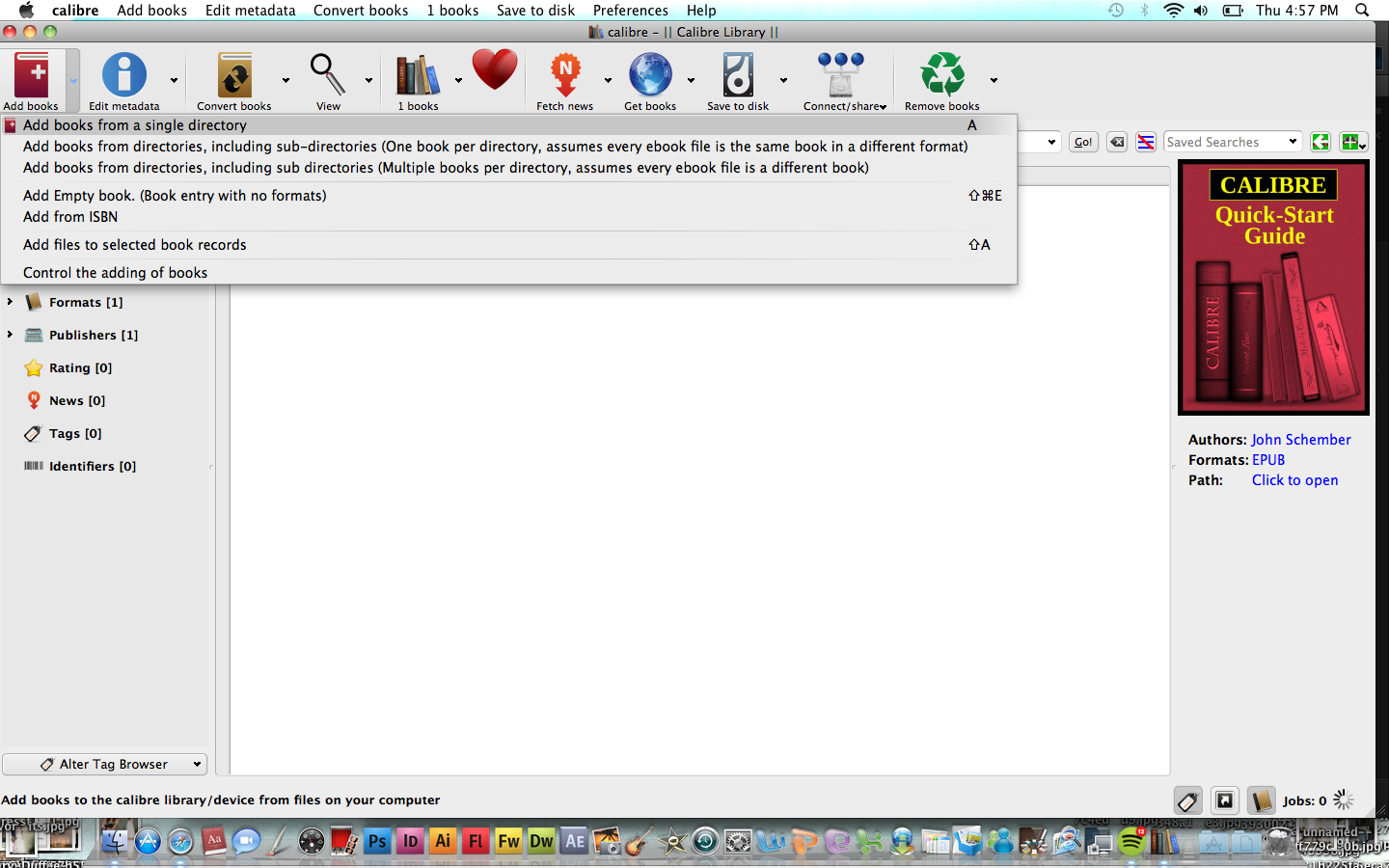
3. Open up Calibre and go to Add books on the top left then Add books from a single directory. Once you click this you will be able to chose the .htm file you saved.


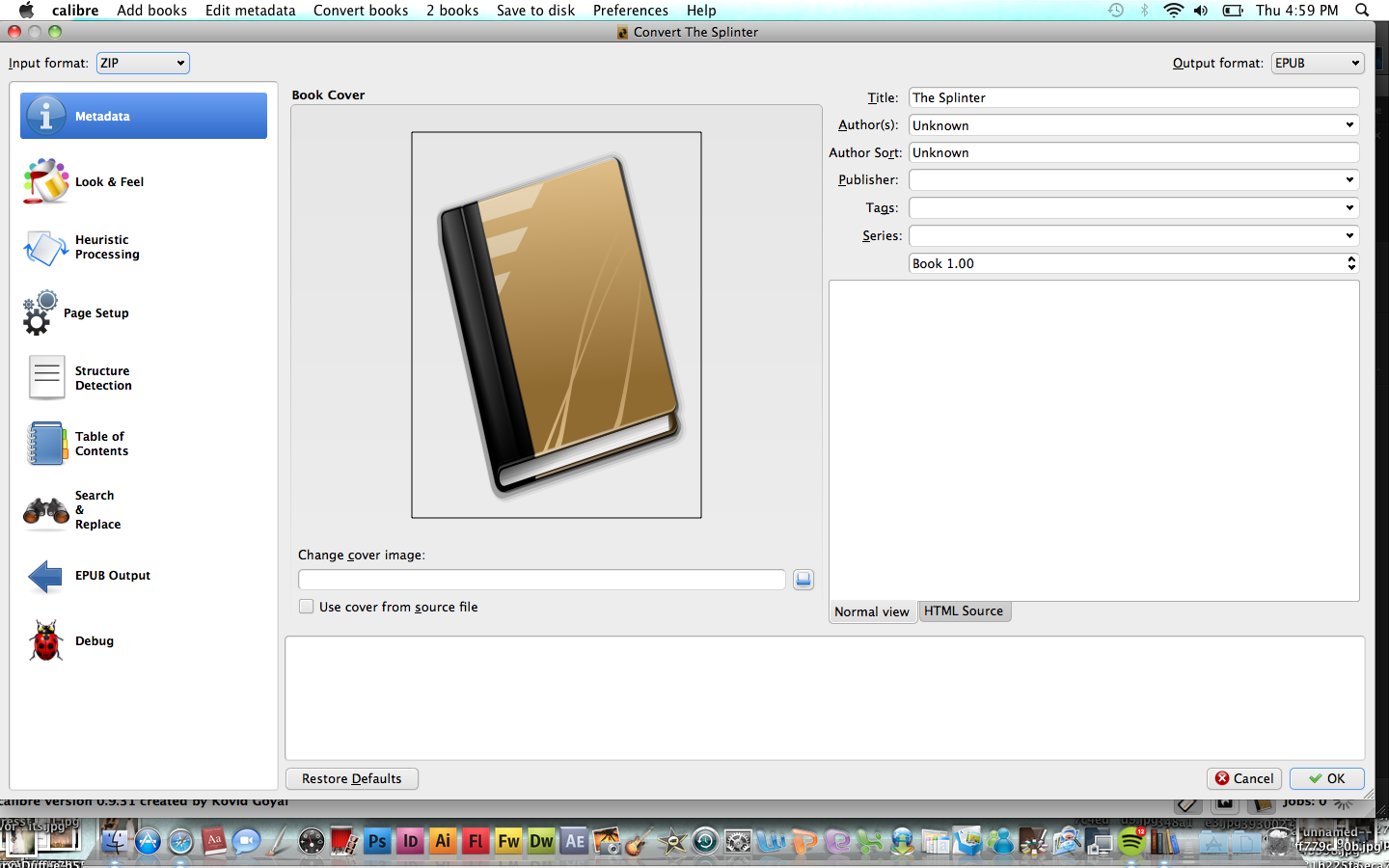
4. Your file will show up in the Calibre main screen. It should be above Calibre's Quick Start Guide. Select your file until it's highlighted blue and go up to Convert books, then Convert individually.

5. A new screen will pop up and, if you really want, you can fill out all of the details. Seeing as mine was a crazy rough draft I left everything as it was and just hit OK. This starts the conversion process. It shouldn't take more than a minute depending on its size.

Now you have an ePub file that can be read on your eReader. All you have to do is search your computer for the file name!

Don't know how to send the ePub file to your eReader?

For Kindle
Connect your Kindle device to your computer. Once it is recognized you will see a new icon at the top of Calibre called Send to Device. Click to highlight the ePub books you want to send to your Kindle and click Send to Device. You will be asked to auto convert. Do it!

Once the job is done, disconnect your Kindle.

For Nook
I like the whole drag and drop process. Connect your Nook and take your new ePub file and drag that sucker to your Nook's Documents. Drop it in and then disconnect!

It may seem complicated but it's super easy and highly effective! Seeing your book on an eReader may give you that pesky push and dose of inspiration you need to finish your book!

Enjoy!
-Tyler Anne (aka Chick Tyler)

Wednesday, May 15, 2013

Writer Talk: Do you Believe in You?


Belief is a funny thing. Whether the belief is in God, Santa Claus or in a friend, the act touches something deep in your core. No matter small or great, very certain or relatively unknown, belief in anything requires a deep level of trust and a leap of faith, at least to some extent. 

I've always personally been someone who likes to believe things, but the meaning of the concept really came alive to me about a year ago when I saw someone pose this question: When does someone become a writer?

At that time, though I had been working for a newspaper for years and literally had my work published, I wouldn't have called myself one. At least not willingly.

I may have said "I write" or "I'm a journalist" but I wouldn't have just gone around telling people I am a writer. 
Essentially, I didn't believe.

I have no idea what my idea of a writer was, but I guess I just always thought something more than what I've accomplished, like publishing a book, maybe even a "successful" book, maybe even getting recognized for it. 

Here's the thing about that kind of train of thought. Sure, I could still write even if I don't believe it, but for the chances of getting someone else to read it or even to finish a project to be present, I really need to buy into it. While a writer might not write only for others to actually read the work, the work itself just won't be the same until you proclaim it to the world—and at minimum, to yourself. 

It's been a year since I decided to declare to myself, on my Website, when people ask me what I do—just everywhere— that I'm a writer. A few weeks later I started to really believe it. A few months later I was supporting myself solely on that skill. And a year later, I'm writing more than I ever have and honestly, better. 

Writers (and I think all creative types really) have a tremendous amount of self-doubt to overcome in the process of creating any work. The true belief in you to come through makes it even possible to complete anything at all. 

If you are a writer or creative person, what has been your biggest tool in overcoming doubt about your work? 

—Holli Anne

Wednesday, May 8, 2013

Writer Talk: Tyler talks music


I've heard the myth about the writer that prefers silence when they write. How they choose to turn everything off and write to nothing but the sound of their fingers hitting keys. They write fight scenes, love scenes, murderous scenes, happy scenes to the sound of nothing.

I'll never understand those people.

Sure, I've written before without a sick beat to help me along but I try not to make a habit out of it. One of the biggest pulls of inspiration I get when writing comes from music. I have had writer's block completely cleared before by just listening to Pandora and stumbling upon a great song. I've created whole scenes that have been born from just listening to that one song. Hell, I've created scenes off of just the openings before.

Music is just one of the most natural ways to make you daydream. That can help you a great deal when trying to weave together your epic tale. 

I've noticed in the past few years that authors are really starting to take notice in how important music is to their books. Some authors go as far as including a list of the songs they wrote certain scenes to in the back of their books as well as others posting entire playlists they wrote to online.

(See, C. Elizabeth Vescio's playlists for The Wasted Series here. I'm a huge fan of them...I MAY follow them already...I do.)

I think that is bitching. 
In the best of ways, of course.

Listening to a song while reading a scene completely changes how you perceive it. Instead of just reading the words and knowing what they mean, music can help you really feel them. 
Was that too cheesy? It's fine!

To be truthful, I wasn't as passionate about this subject until a few years back. I was stuck in the middle outlining--I couldn't figure out how to write climax of the book. That's when Fix You by Coldplay came on. It rocked my effing world. I, not only, wrote the entire climax TO that song but it became the soundtrack for the entire book. It inspired my pants off and helped me work through almost all of the issues I had been facing. Now, I know Coldplay isn't everyone's favorite band and I'm definitely not trying to sell you their albums. I'm just saying that listening to music while you write can really make a big difference in your inspiration levels.

Give it a try! Link your playlists in the comments or tell us YOUR favorite song to write along with!

Here's my writing playlist to the novel I'm working on now. Enjoy!


-Tyler Anne (aka Chick Tyler)

Top photo can be found here.

Wednesday, May 1, 2013

Writer Talk: Mom, I promise I'm not crazy


Tyler Anne's Take
I write about death--grizzly, gritty death. Murder with all the dirty details in tow. My characters go through the ringer and, sometimes, never come back.

I write depressing, deranged, and dark things on a daily basis.

Does that make me depressed, deranged, and murderous?

This post is an intervention to all of those people who read books that aren't all puppies and butterflies and think OH MY GOD, THESE PEOPLE ARE DEMENTED. They aren't. We aren't.

You need to separate the writer from the book and realize they may write murder but they don't actually commit it. (Or at least some of them don't.) Now, I've said it before and I still stand by it--every story you write is an extension of you in some manner. However, when I'm torturing a character in a dark, damp basement I personally don't want to go out, grab a person, drag them to the basement, and water-log them.

The novel I've been working on gets pretty dicey early on. I was afraid I rushed some things so I let my mom have a few chapters to read at her connivence. A week later I got a call from her. She was unusually quiet. Finally, after a few "are you sure you're okay?" she got to what was bothering her.

"Are you okay? I mean, are you happy?"

I had no clue where she'd jumped on that line of thought...until she told me she had read those chapters.  She said that the torture scene was a little too real and the main character's seems a little unbalanced.

I'll tell you what I told her: Mom, I promise I'm not crazy. I just write crazy.

Sure, there may be some dark little jewel inside of me that is morbidly curious about the world but isn't there something like that in all of us? If I judged all of the books' plots I've read against the author, then hot damn there would be a lot of writers out there that are beyond reproach.

So next time you read a book with content that at times makes you squirm, don't jump to conclusions about the author. Instead, turn your focus to how you feel about all the murder and crass.

Holli Anne's Take
My mom is kind of a crime show/novel junky, so when she reads my dark, gritty tales, she always wants more.

My husband, is a different story. His reactions are similar to Tyler's mom: Um, why is this so dark? You aren't going to kill me, are you?

No, honey, I'm not. 

But, will my characters get raped and murdered (or murder and rape others)? Yes, without a doubt. 

Tyler pretty much covered this topic well: Writers who write dark things aren't all crazy. We're just not.
First things first, don't we all have a little darkness in us all? When I write dark twisted things, I don't do it with the intent of committing crimes or even the desire to. I take the deepest darkest part of myself, magnify it by 100 and write a damn good story about humanity.

Second of all, if people didn't enjoy these types of tales, there probably wouldn't be so many crime shows and novels out there. 

So sit back, relax and just enjoy yourself a good piece of twisted fiction!

For more Writer Talk go here.

Friday, April 26, 2013

Writer Talk: So you want to write a book


Holli Anne made a good point yesterday. When you tell someone you're writing a book they either respond with a.) what's it about? and b.) I want to write a book someday too.

I've run into both reactions before and couldn't help but wonder how many of my friends are actually trying to write and finish a book. So, I made the whole "Like this status if you're writing a book" and was surprised at how many people Liked it and messaged me about it.

See, Holli and I have been making Writer Talk plans and were going to wait to unleash later next month but I don't see why we can't do it earlier!

What we did
We created an open group on Facebook called Writer Talk. Go here to see it.

Its purpose is to first and foremost create a sense of camaraderie among aspiring writers. Anyone can be a writer and that makes for an interesting variety of talents. Writer Talk is a place on the internet where you can talk with The Annes and others about what inspires you, what problems you're having, your success stories, and so much more!

What we will do
We will start daily discussions within the group. We will ask questions that are writing-related and offer writing resources on the web.

Another big part of this group will be our prompts! Every now and again we will give you a writing prompt for you to address within the group. We will then pick our personal favorite response (or all of them, depending) and post it as a Writer Talk post on this site! (That is if you are okay with it. We will not post anything by you without your permission!)

What we hope to accomplish
Basically, we love to network and we love to write. This group is mashing those two things together! Writers face very normal and very weird problems from time to time. This group will allow us (and you!) to talk it out with fellow writers who are just trying to realize a very awesome dream--writing a book!

We hope you'll join our group! Remember, go here to join!

Tuesday, April 23, 2013

Writer Talk: Over-sharing & Under-sharing


Over-sharing, under-sharing and letting you know about the apple on the table 


Hello, my name is Tyler and I’m an over-sharer. Don’t want to know what I had for lunch, how it made me feel, and what I thought about while I ate it? Then don’t talk to me after lunch. I am a bottomless pit of talk and I’m not afraid to let my words fly.

I’m not ashamed of this particular personality trait, however, when it comes to writing it can be a bit of a problem.

I have read hundreds of books that walk the line of over-sharing and under-sharing details and books that have fallen in between. I know that giving too much information can be as bad as not giving enough. I want to know what the main character is thinking as he sees the city for the first time but I don’t need to know every single detail in the building to his left or the storm drain next to his feet. On the flip side, you can’t tell me that this is his first time to the city and then let him just walk down the street and into a nondescript house without a new thought in his head.

Getting the details just right is a balancing act in any story you write. At times, it’s a struggle for me to pull in my description reigns because I want need the reader to not only understand my story and characters but to see them as well. As the author I will always know 110 percent more than the reader about my story. I know why she bounces her leg whenever it storms. I know that the police station has a leaky basement causing the captain to have a series of hellish allergies. I know that, after the book ends, Mary is going to have a daughter and name her after her estranged sister.

Some of these details enhance the story; others just distract from it and enable over-sharing tendencies. Unless a detail furthers the readers’ understanding of a plot or character, really think about if it should be in there at all.

I’m going to use a very obscure book as an example of over-sharing.

Jude the Obscure (by Thomas Hardy) made me want to become a character in that book just so I could punch Jude and tell him to stop thinking about nonsense all of the time. You don’t have to know about the plot to know that dear ole Jude couldn’t walk a damned step without analyzing everything around him, how it all made him feel, and at least two flashbacks into his past. If I hadn’t been forced to read it for school I would have put it down within the first chapter (and I normally ALWAYS read past the first chapter).

Sure, some thoughts were relevant to the story. He questioned the love of his life, the way the city made him feel, and a bunch of other important who-am-I issues. However, he also described a ton of things that wasn’t worth a damn to him, me, or the story. Now, I know for a fact that some people insanely love this book (awkward moment: trashing this book to your professor before realizing she did her dissertation on it) and that’s good and all but they can’t deny it is, at best, long-winded.

You don’t need to write out everything that your character feels and sees and smells and touches because you love your story. You automatically know more than anyone about your story and you should keep it just like that. Your story, no matter the plot, is an extension of you and you need your secrets. Sometimes I tell you more than you need to know about my main, sometimes I don’t tell you enough to put together who-done-it, and sometimes I just want you to know there’s an apple sitting on the table.

At the end of the day it’s still your story. You can over- and under-share all you want, just remember that there are people who will put down your book in a heartbeat if you abuse either option. Don’t make them compare your story to Jude the Obscure.

-Tyler Anne (aka Chick Tyler)

LinkWithin

Related Posts Plugin for WordPress, Blogger...
Pin It button on image hover